Sunday morning 10am
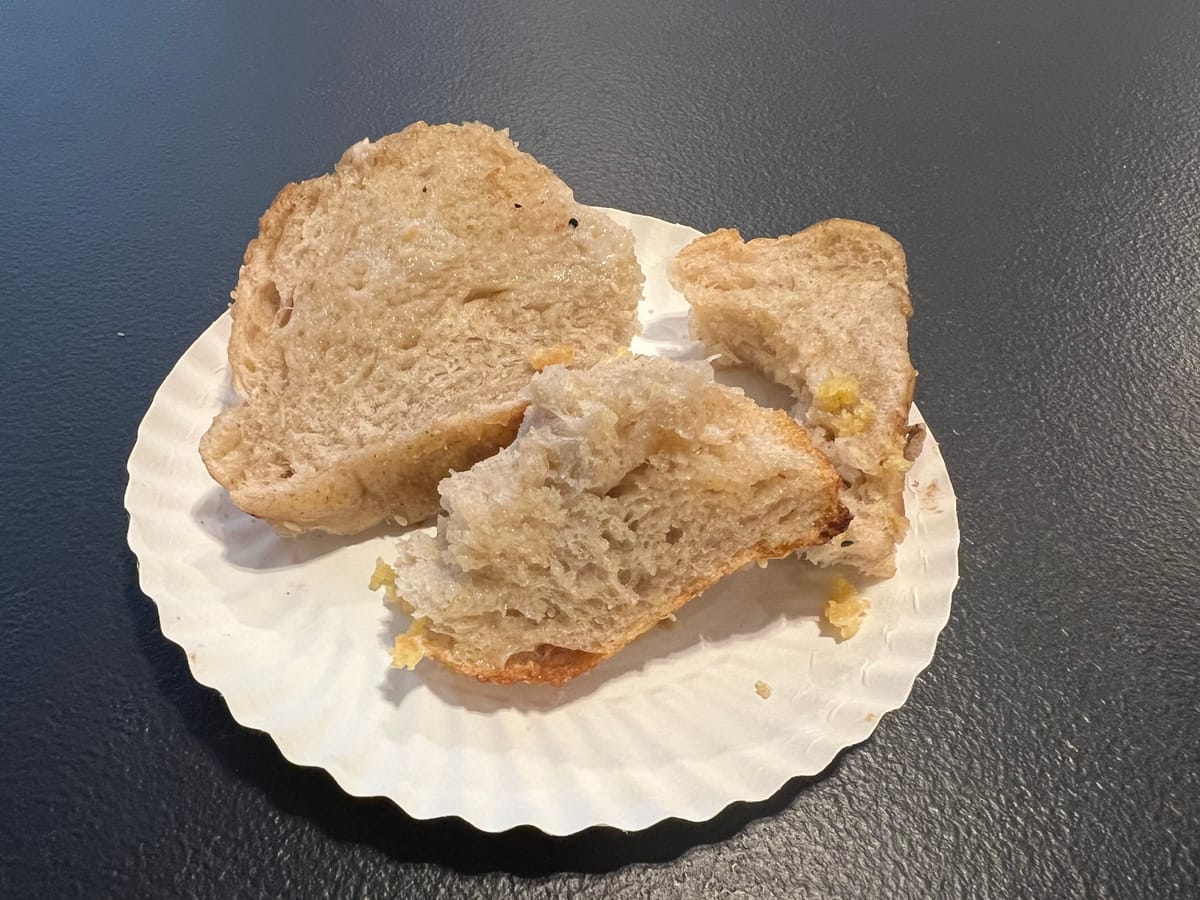
G brings bread, two warm loaves, sliced. There's butter on its waxy paper.
K chose the reading from the Big Book – from Chapter 4, We Agnostics.
When I was a child I went to church with my father. Mother didn't like church. She didn't like me much either. More people liked me at church than at home, so I liked church, and singing in the choir, ringing the bell with Papa James, even the flannelboard in the basement.
One of the many go-to-your-room-without-dinner evenings, sobbing into the bedspread, I heard myself say, "Well, Jesus loves me." I had no vivid sense of who that was, but the people at church were sure of it, and I got through a lot of years thanks to the fallback certainty that somebody, somebody loved me.
Sister Superior, Mary Barbara, kicked me out of the choir senior year in high school. "If you're not going to say the Creed you're not going to sing it." I was done with church, those hypocrites. Jesus? Another lie like Santa Claus. Child abuse.
Pissed me off for the next fifteen years when I heard the hymn channel playing in my head. And then, in a what-is-my-life-for-anyway? visit back to that school, I 'came to believe' or at least be open to the possibility that, despite the church's desecration, the love they wrote about was real, the source and sustenance of all. Beyond words, not just the wrong ones. That's what my life could be for! Nothing personal, exactly.
I was at a clergy conference some years later when the distinguished, scholarly speaker said, "We pray to Jesus..." During a break, I said, "We do not pray to Jesus, we pray to God 'through Jesus Christ our Lord Amen.'" He said, "Oh, of course, that's the case." We're talking Common Prayer here. By the book. An older priest chimed into the conversation, his tone happily incredulous. He said, "What do you mean? I pray to Jesus all the time!"
A few years later, the day after Christmas, I joined the people meeting in the church basement who had found that something beyond theory answered them. Each of them. Whomsoever meaneth me! (That hymn is not in Our hymnal.)
If a mere code of morals or a better philosophy of life were sufficient to overcome alcoholism, many of us would have recovered long ago. But we found that such codes and philosophies did not save us, no matter how much we tried. We could wish to be moral, we could wish to be philosophically comforted, in fact, we could will these things with all our might, but the needed power wasn’t there. Our human resources, as marshaled by the will, were not sufficient; they failed utterly. Lack of power, that was our dilemma. We had to find a power by which we could live, and it had to be a Power greater than ourselves. Obviously. But where and how were we to find this Power? Well, that’s exactly what this book is about. Its main object is to enable you to find a Power greater than yourself which will solve your problem. That means we have written a book which we believe to be spiritual as well as moral. And it means, of course, that we are going to talk about God.
Alcoholics Anonymous World Service Inc.. Alcoholics Anonymous, Fourth Edition: The official "Big Book" from Alcoholic Anonymous (p. 24). (Function). Kindle Edition.
Keep coming back.